Guide
Guide to Milan's markets
How the neighbourhood markets work, plus guides to the seasons, neighbourhoods and Milan outdoors.
A bit of history
Milan's covered neighborhood markets date back to 1930, when mayor (podestà) Marcello Visconti di Modrone began building a network of markets across the city's working-class neighborhoods.
The goal, set at Palazzo Marino on November 22 of that year, was for every Milanese resident to reach one within half an hour's walk, no more than a mile and a half from home. Stall prices were regulated by the city, meant to keep private shops honest.
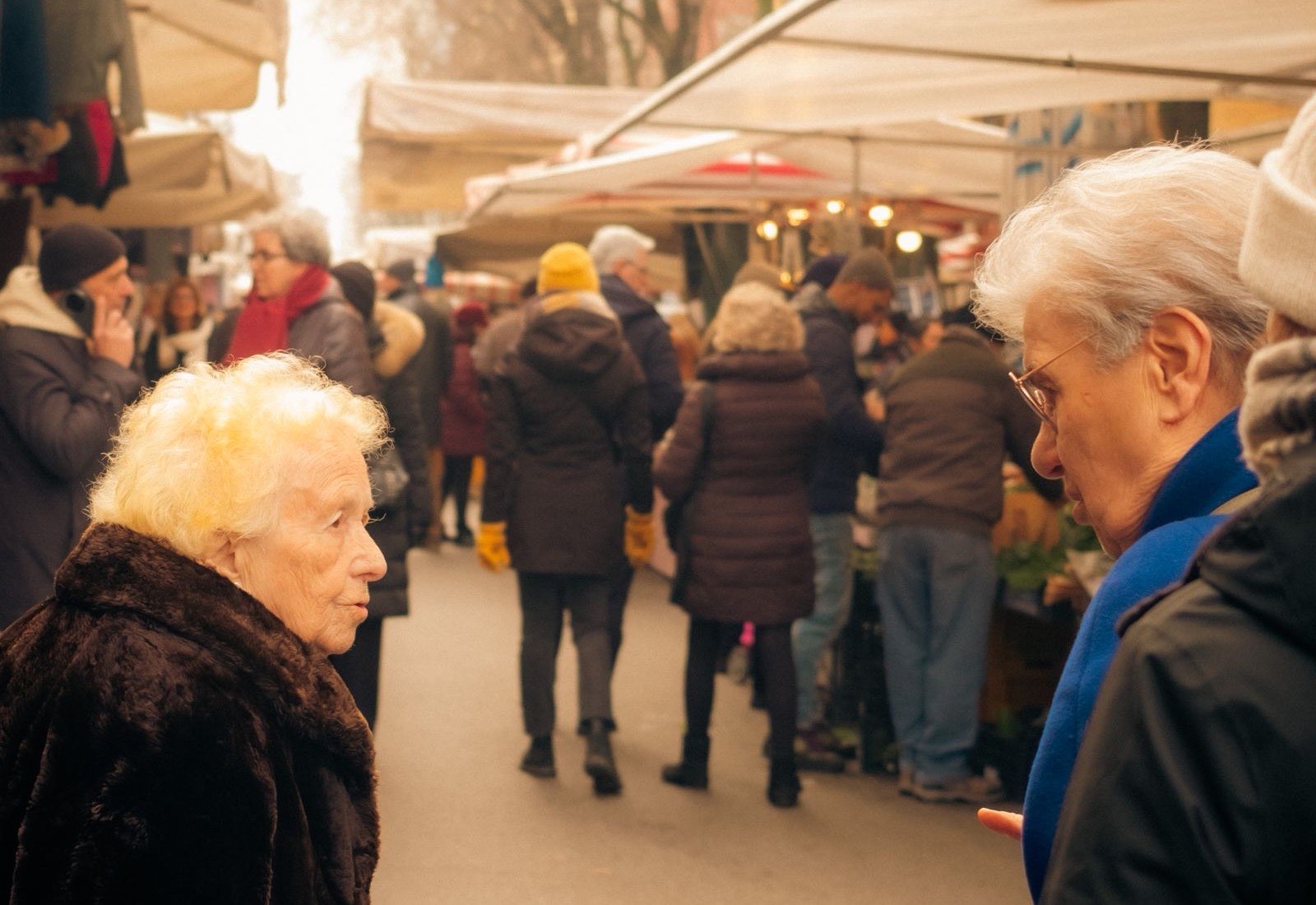
That is where the very Milanese habit of having "your market" on a fixed day of the week comes from. The open-air markets on this site are the evolution of that idea: not buildings anymore, but vendors who take over a street for one morning a week, always in the same spot.
How they work today
Milan has roughly a hundred street markets across every district. This site's full list covers 85 of them, the open-air weekly ones.
They almost always run Monday to Saturday, a couple on Sunday, and only in the morning: open around 7:30 AM, closed by 2:00 PM. On market day the street closes to traffic and reopens right after the stalls pack up.
When to go
The best window is between 9:00 AM and noon. Before 8:30 many stalls are still setting up.
After 1:00 PM the selection thins out, but that is also when vendors discount whatever fruit and vegetables are left rather than pack them back up.
Payments
Nearly every stall takes card payments today. For very small purchases, under 5 euros, cash is still more convenient and often the vendor's preference.
Practical tips
Bring your own bags: plastic bags at the stalls almost always cost extra. If you're driving, the market street itself is closed to traffic, so try the parallel streets, the metro or a bike.
Markets run rain or shine: food stalls almost always have some kind of cover.
Find your market
Use today's page to see which markets are open right now, the full list to filter by day or district, or the map to find the one closest to home. Some of the oldest ones are officially recognized by Regione Lombardia: find them on the historic markets page.
More guides
Milan neighbourhoods, explained
A practical map of Milan's neighbourhoods: how the 9 municipi are divided, what sets Isola, Navigli, NoLo, Città Studi, Porta Romana and the rest apart, and where each one's market is.
Where locals actually shop in Milan
Beyond the supermarket: how Milanese people combine street markets, covered municipal markets, neighbourhood shops and buying groups for everyday food.
Milan on a Sunday
What is open in Milan on a Sunday: the few Sunday street markets, the antiques fairs, the right neighbourhoods for a walk, and what stays shut.
Milan street food: what to eat and where
Milan's real street food: panzerotti at Luini, pizza al trancio at Spontini, fried mondeghili, market rotisserie and the fried fish stall. What to order, what it costs and where to find it.
Eating from the market in Milan
How to have a cheap lunch at a Milan neighbourhood market: the rotisserie, the fried fish stall, savoury tarts, the food trucks that follow the markets and what to grab for a quick meal.
Aperitivo in Milan: how it actually works
The Milanese aperitivo explained: where it comes from, what apericena is, where to go across the Navigli, Brera and Porta Venezia, what it costs, what time, and the two cocktails invented in the city.
Milan on a budget: eating and seeing the city for less
Milan has a reputation as an expensive city, but you can visit it well on a small budget: free museums on the first Sunday of the month, markets for eating, parks, churches and cheap transport. The practical guide.
Milan in the rain
What to do in Milan when it rains: the covered municipal markets, the Galleria and a dry city centre, museums for an afternoon, the churches, and the street markets that run anyway.
Milan in August
Milan in August is half-empty and hot: which markets and museums stay open, what closes among shops and neighbourhood restaurants, how Ferragosto works, and why prices are the lowest of the year.
Milan with kids
Milan with kids: parks with playgrounds district by district, the science museum and the aquarium, a morning at the market, and what to do when it rains. With a map of playgrounds by district.
Milan on a Saturday
What to do in Milan on a Saturday: the day of the biggest markets, the Fiera di Sinigaglia, shopping and a long aperitivo. How the day is organised and what to avoid.
Milan in one day
What to see in Milan in one day: a walking itinerary from the Duomo to the Castello to the Navigli, what to book ahead, where to eat quickly and how to end the day.
Milan by bike
Milan by bike: the city is flat and compact, with cycle paths along the Navigli and the Martesana, the BikeMi bike share and connected parks. Routes, rules and what to know about theft.
Milan with a dog
Milan with a dog: nearly 300 dog areas mapped by district, the parks to run in, the rules on metro and tram, and how dog-friendly the city is in bars and shops.
Milan month by month
What Milan is like each month: weather, events, closures and long weekends, and what is in season.
Seasonal produce
A month-by-month calendar of what is in season at Milan's markets, from April asparagus to autumn pumpkin.
Flea, vintage and antiques markets
Antiques, mid-century and vintage in Milan: Sinigaglia, the Naviglio Grande, East Market, Brera and Cordusio.
Milan Christmas markets
The Christmas markets that come back every year: Oh bej! Oh bej!, the Villaggio delle Meraviglie, Piazza Duomo, the Navigli and Chiaravalle.