Milan neighbourhoods
Gallaratese
A 1970s satellite quarter, known for a building by Aldo Rossi.
- Market
- Tue · Fri · Sat · 2 markets see below ↓
- Transport
- M1 Gallaratese, M1 Uruguay, M1 Bonola, M1 San Leonardo (terminus); trams 12, 14; buses 40, 68; Lampugnano coach station
- District
- 8
What it's like
Gallaratese lies at the far north-west, beyond the Certosa and Portello, in an area that until the 1960s was farmland.
In a few years an entire quarter for tens of thousands of residents was built here, with towers, slab blocks and shopping centres around the new M1 stops.
Its most celebrated piece is the Monte Amiata complex, designed by Carlo Aymonino with a separate building by Aldo Rossi: a long white slab with a portico and columns, one of the manifestos of 1970s Italian architecture, studied in universities around the world.
Around it, Gallaratese is an orderly, green residential quarter, with the large Parco di Trenno to the west, the Bonola shopping centre and the Lampugnano coach station, from which buses leave for half of Italy.
The market
Bonola
District 8 · Quartiere Gallaratese - Quartiere San Leonardo - Lampugnano
Falck
District 8 · Quartiere Gallaratese - Quartiere San Leonardo - Lampugnano
See the area's markets in detail →
Covered markets
Green space and the outdoors
Parks
Dog areas
- parco Sandro Pertini · 1061 m²
- via Lampugnano · 1145 m²
- vie Appennini - Consolini - Bolla · 601 m²
- giardino Pierangelo Bertoli · 1764 m²
- via Chiarelli · 1029 m²
Playgrounds
- parco Sandro Pertini · 1390 m²
- via Balla · 113 m²
- via Ojetti n. 15 · 977 m²
- via Cilea n. 52 · 946 m²
- vie Borsa - Falck - Appennini · 577 m²
- via Lampugnano n. 145 · 814 m²
Where to eat and drink
Gallaratese has a neighbourhood food offer and the restaurants of the Bonola and Molino Dorino shopping centres; a few historic trattorias survive in the old Trenno core.
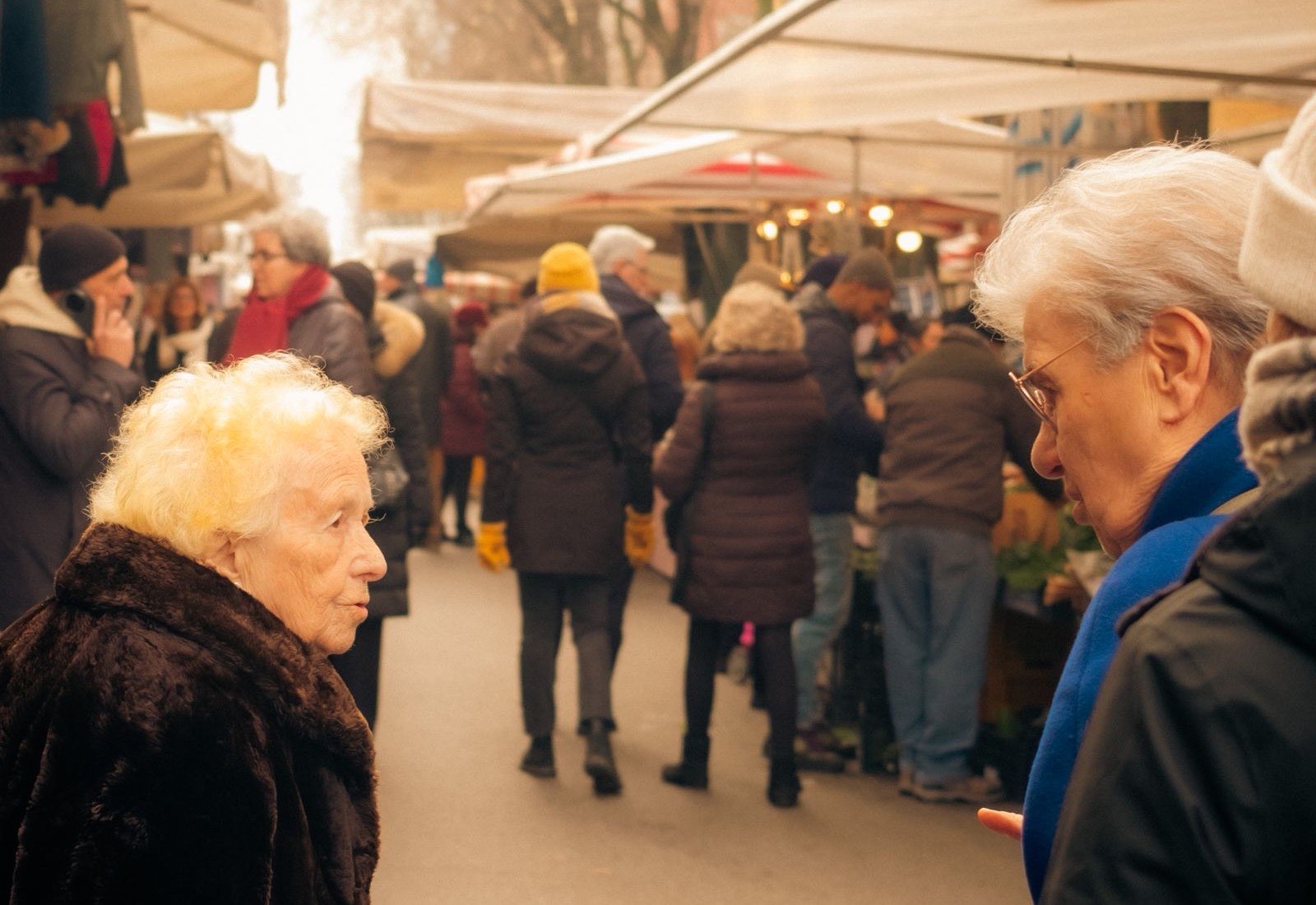
The quarter has two street markets: via Quarenghi / Bonola on Tuesday and Friday, and via Falck on Saturday.
Getting there
The red M1 crosses the whole of Gallaratese with four stops, from Gallaratese to San Leonardo, the terminus of one of the line's branches.
At Lampugnano there is the large long-distance coach terminal and a park-and-ride. On the surface there are trams 12 and 14.
M1 Gallaratese, M1 Uruguay, M1 Bonola, M1 San Leonardo (terminus); trams 12, 14; buses 40, 68; Lampugnano coach station
Frequently asked questions
What is the Monte Amiata in Gallaratese?
It is a large 1970s residential complex designed by Carlo Aymonino, with a distinct building by Aldo Rossi: a white slab with a portico and columns, considered one of the most important works of post-war Italian architecture.
How to get to the Lampugnano coach station?
By the red M1, Lampugnano stop, right in front of the terminal. Long-distance coaches leave from there for much of Italy and for the airports.
Nearby neighbourhoods
Data: City of Milan — weekly open-air markets (DS291), CC-BY. Reviewed .